
Why the Same Defect Gets Missed on the Factory Floor and Caught by the Customer

A part passes final inspection on the factory floor. Days later, the customer opens the box, looks at the same part under different lighting, and spots a scratch your inspector did not.
Nobody swapped the part. Nobody skipped a step. The defect was there the whole time. It simply was not visible under the conditions in which it was inspected.
When this happens repeatedly, it is easy to look for the weak link: a rushed operator, a missed step, or a bad shift. But sometimes, that search turns up nothing. The inspection was performed correctly according to the process. The part simply looked different under two different sets of conditions.
That points to a structural gap in how inspection conditions are designed and validated, rather than a failure to follow the process.
Inspection conditions decide what gets detected
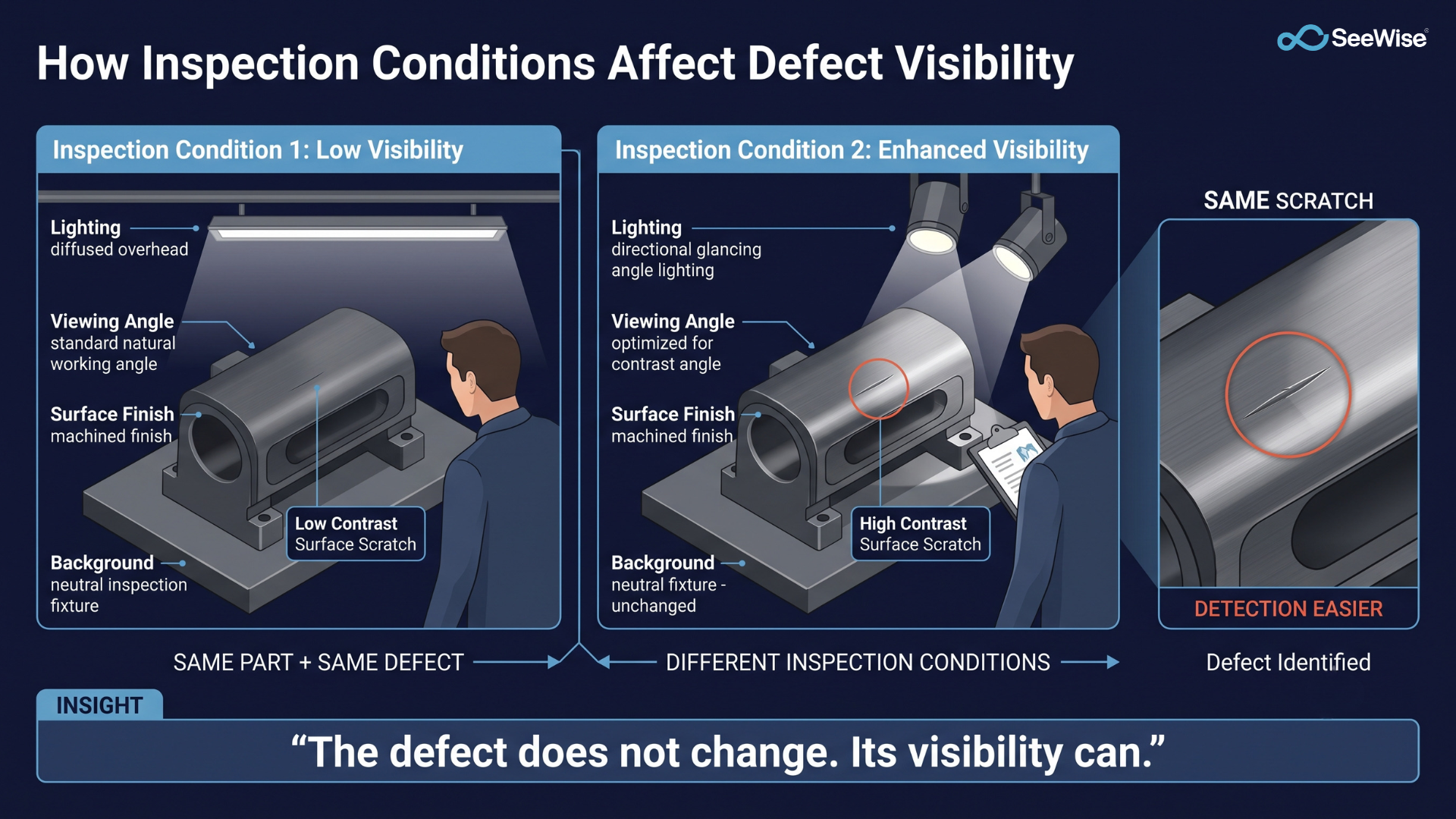
A defect is not equally visible under every condition. Whether it gets caught can depend on the combination of lighting, viewing angle, surface finish, and background. Those conditions are rarely identical on the factory floor and at the customer's location.
Take a scratch on a machined metal component. Under diffuse overhead lighting, a shallow scratch may blend into the surrounding surface texture. There may be little shadow or contrast for the inspector to notice.
Place the same part under a more directional light source, and the scratch may produce a visible shadow or reflection. The scratch has not changed. The way the light interacts with it has.
Viewing angle matters too. A defect that is visible from one angle can become difficult to see when the part is viewed straight on. An inspector working at a fixed station may never naturally view the surface from the angle that makes the defect stand out.
Surface finish adds another variable. A scratch on a matte-painted panel can behave differently from one on a reflective or coated surface. The lighting that makes a defect visible on one surface may not provide the same contrast on another.
This is why a part can pass inspection in one environment and fail in another. The inspection conditions influence what the human eye can actually detect.
Why this is a structural problem, not an operator training problem
It is worth being direct: the operator may not have made a mistake.
They may have inspected the part exactly as the station allows them to. The bigger question is whether the station itself was designed and validated to reveal the defects it is expected to catch.
Many inspection stations are set up for general visibility. There is enough light to see the part and perform the task safely, but there may not be a documented validation showing that the lighting, angle, distance, and background reliably reveal a specific defect at the required detection size.
Without that validation, the station's ability to catch a particular defect can become inconsistent.
The conditions can also change without anyone deliberately changing the process. Lighting fixtures lose intensity over time. Ambient light can vary between shifts, especially around windows or other sources of natural light. Operators may also position or handle parts slightly differently.
These changes are not necessarily training problems. They are condition changes.
That is why repeatedly retraining inspectors may treat the symptom without addressing the underlying gap. If the inspection environment does not consistently reveal the defect, putting a different operator at the same station does not solve the problem.
The customer becomes the final inspection stage
When a defect escapes internal inspection, it does not disappear. It simply waits for a set of conditions that makes it visible.
Often, those conditions appear when the customer handles the part, changes its angle, or views it under different lighting during receiving or unpacking.
From the customer's side, it looks like quality control missed something obvious. From the factory floor, the same defect may genuinely have been difficult to see under the conditions in which it was inspected.
Both can be true at the same time.
The cost also increases the further downstream the defect travels. A scratch caught at the inspection station may require only a few seconds of rework. The same scratch found by a customer can lead to returns, re-inspection, additional freight, production disruption, and lost confidence.
If the same type of defect repeatedly reaches customers, it is worth asking whether the inspection setup was capable of consistently detecting it in the first place.
What consistent inspection conditions actually require
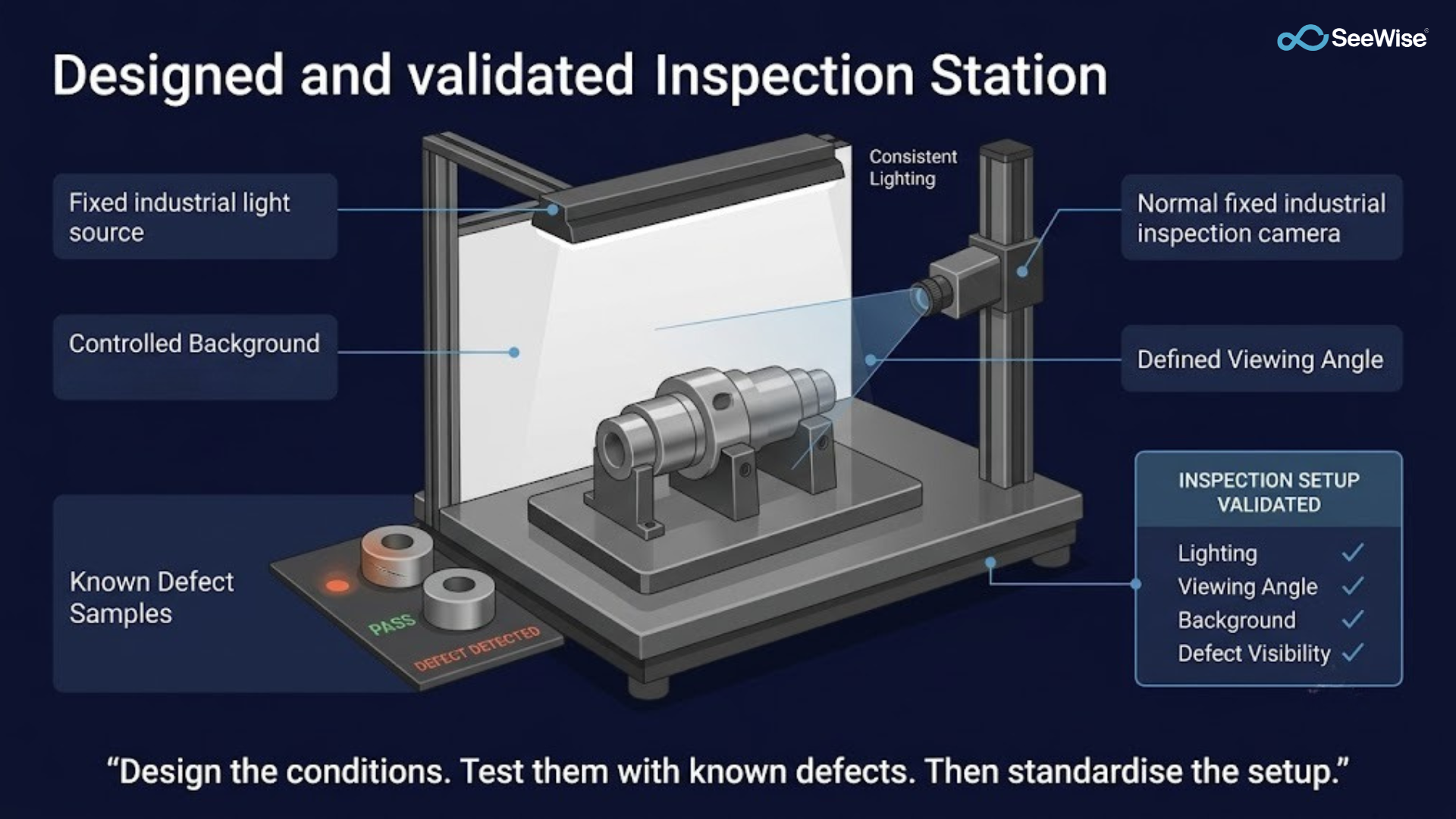
Fixing the problem does not start with better operators. It starts with treating inspection conditions as something that needs to be designed, standardised, and validated.
That means using controlled lighting conditions suited to the defect types and surface characteristics being inspected. It means choosing viewing angles based on how the relevant defects become visible, rather than relying only on what is convenient at the station.
It also means keeping the inspection environment consistent across operators and shifts, so the same part is not easier to pass at one time of day than another simply because the surrounding conditions have changed.
Most importantly, the setup should be validated using known defect samples before production begins. If a station is expected to detect a particular scratch, coating inconsistency, or other surface defect, the inspection setup should demonstrate that it can reliably reveal it.
Where Vision AI can help
Maintaining that consistency through manual inspection alone can be difficult. Operators change, lighting conditions drift, and production environments are rarely perfectly static.
This is where Vision AI can add value. Instead of relying entirely on what an individual inspector can see under changing conditions, a Vision AI system can use a defined inspection setup to consistently analyse the same areas of a part against established quality criteria.
Seewise AI is one approach to standardising the inspection view and continuously monitoring for defined visual defects, reducing dependence on changing human viewing conditions.
The goal is not to replace the inspection process with AI. It is to make the inspection process more consistent and repeatable.
A defect that your inspection misses and your customer catches is not always, at its root, a defect problem or an operator problem.
Sometimes, it is an inspection condition problem.
The fix is to build inspection conditions that are designed and validated to reveal the defects that actually matter, consistently and repeatably, regardless of who is on shift or how the surrounding environment changes.

Why the Same Defect Gets Missed on the Factory Floor and Caught by the Customer