
Why End-of-Line Inspection Catches Defects Too Late, and What It Actually Costs
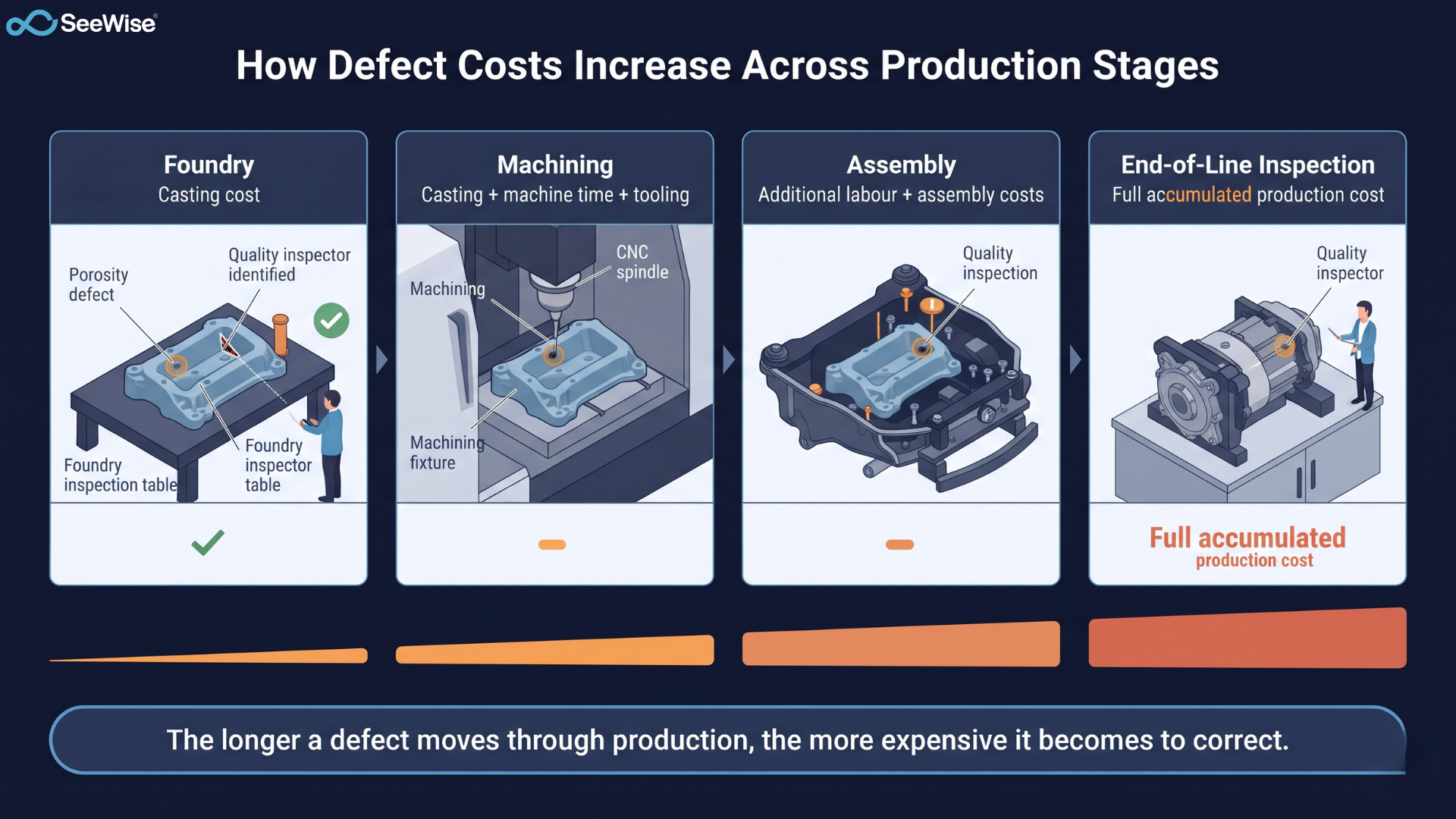
A porosity defect in an aluminium casting costs the price of the casting. If it is caught at the foundry, you scrap one casting. If it is found after machining, you have lost the casting, the spindle time, the tooling wear, and the fixture setup. If it is found at end-of-line, after assembly, you have also lost the labour, the fasteners, the finishing, and often the entire unit.
The defect never changed. Only the amount of value attached to it did. This is why end-of-line inspection, while necessary, catches defects at one of the most expensive points in the production process.
Why Defects Become More Expensive Over Time
The Rule of Ten is a commonly used quality management principle that illustrates how the cost of correcting a defect can increase significantly at each successive stage of production. While the actual multiplier varies by plant and process, the underlying principle remains the same: every additional stage adds material, machine time, labour, and handling costs that cannot be recovered.
Consider a food and beverage production line. A seal defect on a pouch caught at the filler costs one pouch and a few seconds. The same defect found at the case packer costs the product, the pouch, the label, and the carton. If it is found after palletising, someone may have to break down and re-inspect an entire pallet. If it reaches a retailer, the costs can include recalls, credit notes, and damaged customer relationships.
Most quality managers understand this cost progression. Yet, in many plants, final inspection remains the primary quality gate. Understanding the cost of late detection and acting on it are two different things.
These additional expenses contribute to the overall cost of quality, which manufacturers need to track to understand the financial impact of defects.
Why End-of-Line Inspection Remains the Default
There are practical reasons why manufacturers continue to rely on end-of-line inspection.
- It is easier to implement. A finished product is accessible, stable, and easier to inspect. A component moving through a machining cell or filling line is harder to reach and measure without affecting production.
- It is often required. Customers, industry standards, and quality procedures expect a final inspection. It cannot simply be removed.
- It is simpler to add. A final inspection station can be introduced without significantly changing the existing production process. In-process inspection requires more planning and integration.
- Its costs are visible. Returns, rework, and scrap appear in quality reports. The cost of operating without earlier inspection is less obvious until a problem occurs.
That last point matters most. The expense of late defect detection is spread across scrap bins, overtime, rework benches, and customer complaints. It rarely appears as a single cost, making it easier to overlook.
What End-of-Line Inspection Cannot Do
End-of-line inspection helps prevent defective products from reaching customers. However, that is different from preventing defects from moving through production.
It cannot prevent defects from being produced. By the time a part reaches the final inspection station, the material, machine time, and labour have already been invested. Inspection only determines what happens next: whether the part is approved, reworked, or scrapped.
It provides delayed process feedback. Finding a defective part at the end tells you it failed, but the feedback may arrive too late to prevent further production of the same defect. If a die starts wearing out at 8 a.m., you may not identify the issue until the 11 a.m. batch reaches final inspection. By then, several more parts may already require rework or rejection.
Inspection quality can suffer under production pressure. When schedules tighten and production volumes increase, inspection teams may face pressure to work faster. A visual check that normally takes ten seconds per unit may be reduced to four. In an electronics plant, this could mean a solder bridge on a circuit board gets missed during a shipment push.
Defect escapes carry higher consequences. A defect that passes the final inspection stage is no longer just a plant-level quality issue. It becomes a customer problem. For safety-critical products, such as automotive brake components, pressure fittings, or medical packaging, an escaped defect can affect product safety, regulatory compliance, and customer trust.
What In-Process Inspection Adds
In-process inspection does not replace the final quality check. It changes what the final inspection station has to deal with by identifying defects earlier in production.
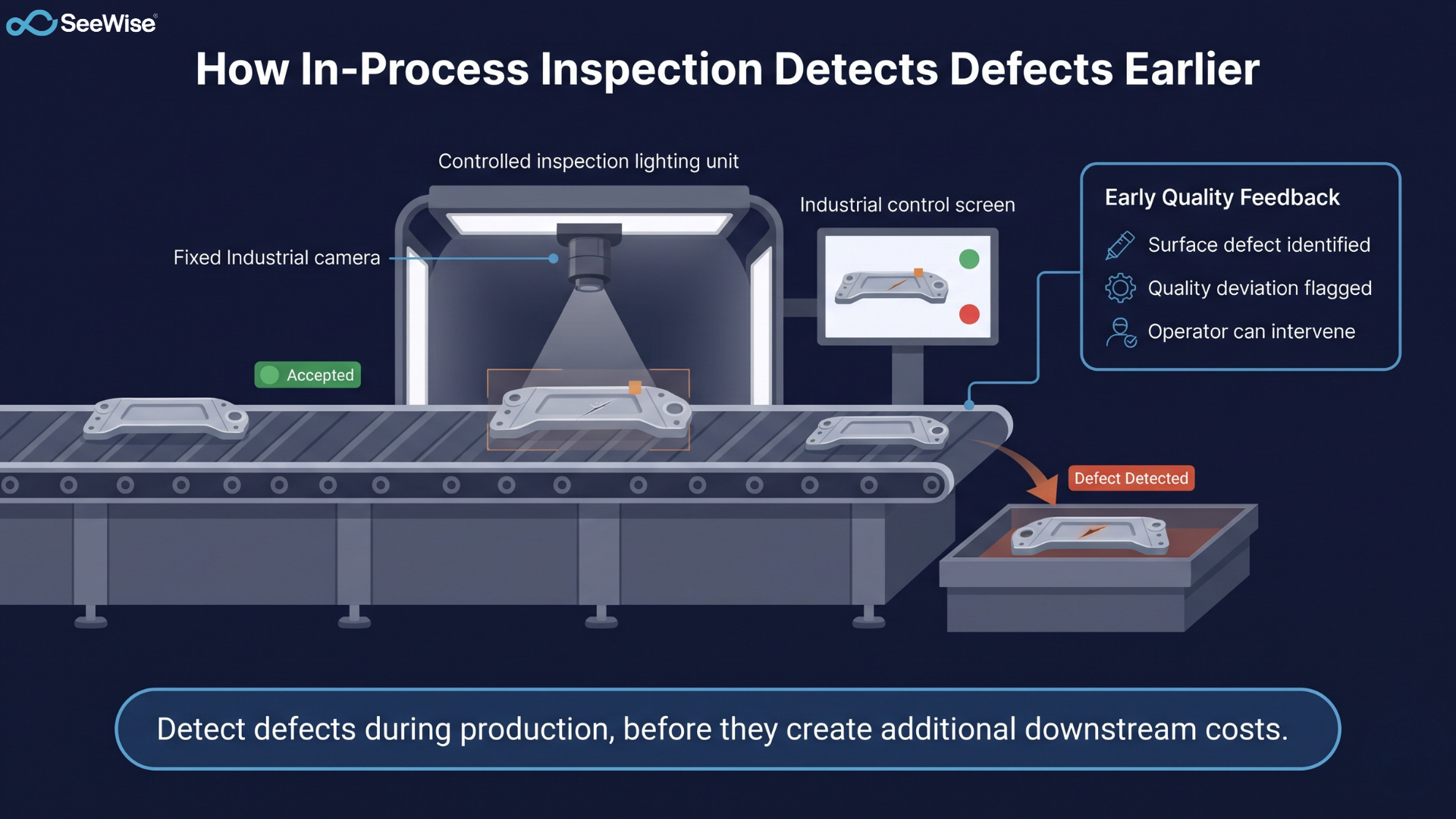
It catches defects while the part is still cheaper to reject. A casting rejected before machining costs the casting itself. Catching the same defect after machining also means losing the additional time and resources invested in it.
It provides feedback when action is still possible. If a camera or sensor identifies a drifting dimension or surface defect on part 40, the operator or production team can investigate before part 41 is made. This can prevent an entire batch from becoming suspect. Vision-based inspection systems can monitor components during production, identify visible defects, and flag quality deviations for timely intervention. Solutions such as Seewise help manufacturers bring these checks closer to the point of production rather than relying entirely on final inspection.
Before introducing such systems into production, manufacturers can evaluate their performance under actual operating conditions through a Vision AI pilot.
It reduces the load on final inspection. When fewer defective parts reach the final station, inspectors can focus their attention on identifying genuine quality issues. This can help reduce rework queues, improve inspection efficiency, and lower the risk of rushed checks.
It supports quality and productivity together. Preventing defective parts from moving downstream reduces wasted machine time, unnecessary rework, and the possibility of quality escapes. It also helps production teams maintain more consistent output.
Moving Quality Checks Closer to Production
End-of-line inspection remains an important part of manufacturing quality control. Customers expect it, standards require it, and it continues to serve as the last line of defence.
However, relying on it as the primary quality gate means defects are often discovered after significant time, material, and labour have already been invested.
The objective is not to eliminate final inspection. It is to identify defects earlier, reduce the number of defective parts moving downstream, and give production teams the information they need to act before a small issue becomes a costly problem.
Every defect caught earlier is an opportunity to reduce waste, protect production efficiency, and maintain product quality.

Why End-of-Line Inspection Catches Defects Too Late, and What It Actually Costs