
What a 14-Day Vision AI Pilot in a Factory Actually Looks Like
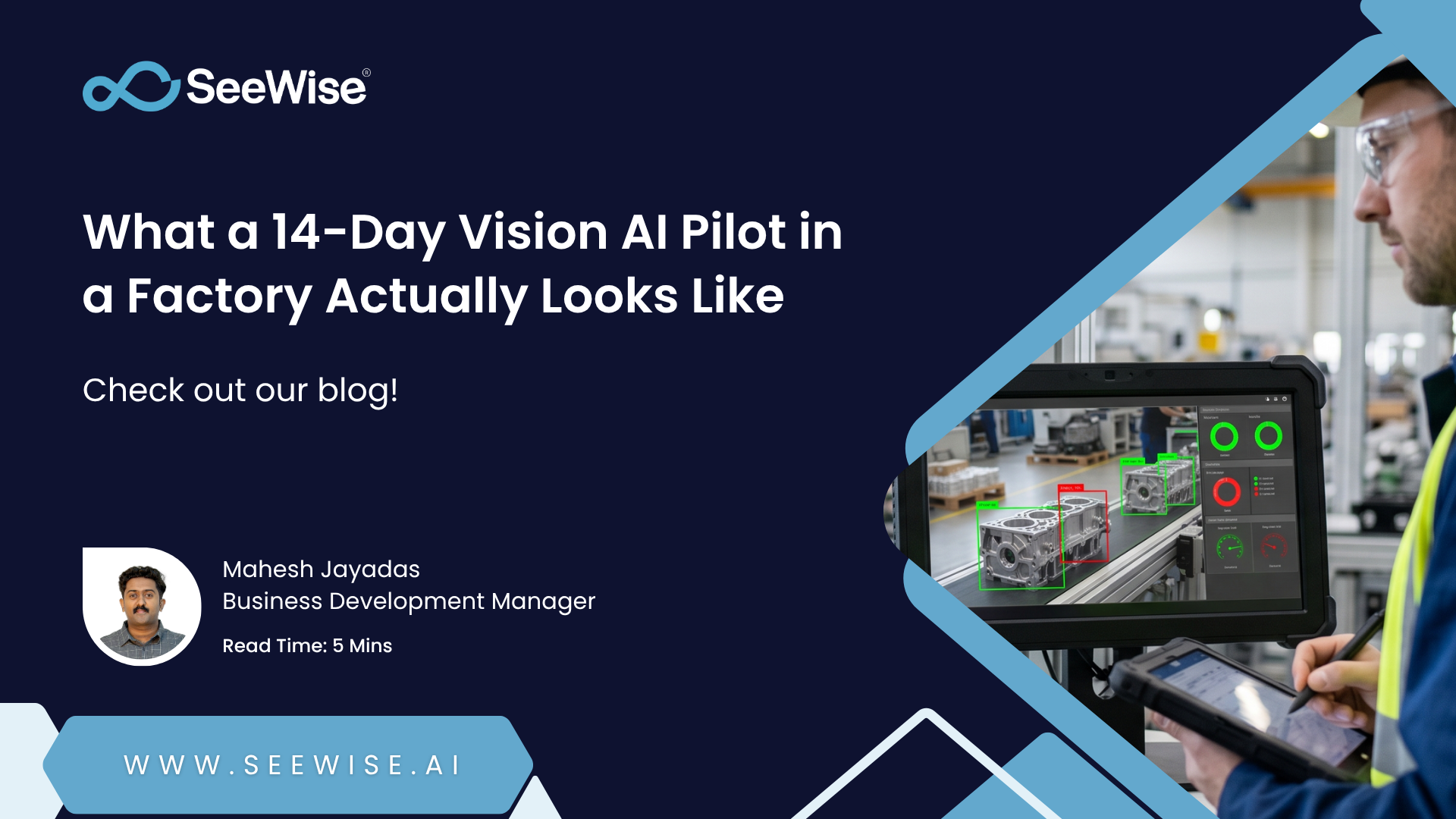
Most factory AI pilots fail to answer the one question manufacturers actually care about: Will this work on my production line?
The problem is rarely the technology itself. It's the way the pilot is designed.
Too often, the system is tested on a clean, well-lit section of the line, with a limited product range and ideal operating conditions. The results look impressive until the pilot moves into day-to-day production, where lighting changes between shifts, products vary, and defects are far less predictable. That's when accuracy starts to fall.
A meaningful pilot reflects real production, not ideal conditions. It takes a little longer to set up, focuses on the defects that matter most, and gives manufacturers a realistic picture of how the system will perform after deployment.
At Seewise, we've built our 14-day Vision AI pilot around this approach. Rather than demonstrating the technology under controlled conditions, the goal is to evaluate how it performs on an actual production line using the manufacturer's products, processes, and operating environment. Here's what that process typically looks like, with automated quality inspection as the primary use case while capturing safety and productivity insights through the same camera infrastructure.
Phase 1: Site and Process Assessment (Days 1 to 3)
The first three days are spent understanding the production line before any hardware is installed.
The team walks the process to identify where defects occur, how products move through the line, and where cameras can provide the best visibility. Camera placement is planned around the actual workflow, not an idealised layout.
Real operating conditions also matter. A camera that performs perfectly during a daytime walkthrough may face very different lighting during the night shift. Likewise, a polished metal component, a matte-finished part, and a painted surface can all appear differently under the same camera. If the line produces multiple SKUs or finishes, that variation needs to be documented early so the model is prepared for it.
This phase also involves speaking with the people performing manual inspections. Which defects are they consistently finding? Which ones are frequently missed? Understanding these gaps helps define the pilot around the issues that affect production rather than around defects that are simply easier for AI to detect.
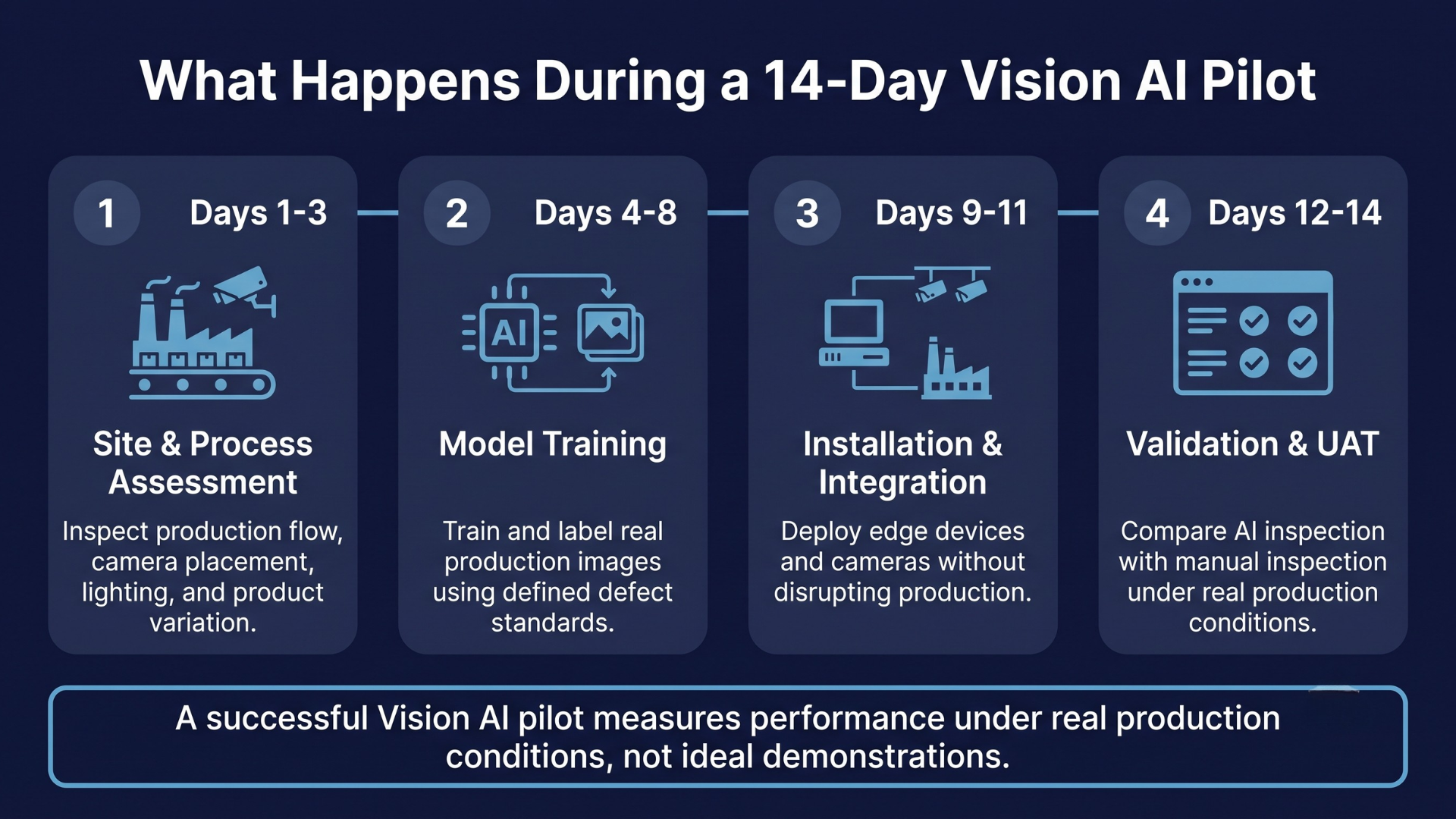
Phase 2: Model Training and Configuration (Days 4 to 8)
Once the pilot scope is defined, the focus shifts to training the inspection model.
The model learns from images collected on the actual production line, not from generic datasets. Just as important is the consistency of those labels. If one inspector labels a surface scratch as acceptable while another marks the same defect as a reject, the model learns conflicting standards. No amount of additional training can fully compensate for inconsistent labelling.
Agreeing on defect definitions before training begins is one of the most overlooked steps in a pilot, yet it often has the greatest impact on the final accuracy.
While the inspection model is being configured, the same camera infrastructure can also be set up for applications such as PPE compliance, restricted zone monitoring, or people presence detection. Since the cameras are already installed, these capabilities run alongside quality inspection without requiring a separate pilot.
Phase 3: On-Site Installation and Integration (Days 9 to 11)
By this stage, the model has a reliable baseline and is ready for deployment on the production line.
In most manufacturing environments, Vision AI processing runs on-premise at the edge rather than relying on cloud connectivity. Factory networks are often restricted or unreliable, and inspection decisions need to happen in real time without waiting for data to travel to a remote server.
The installation is designed to minimise disruption. Cameras and edge devices are integrated into the existing production setup without requiring major line modifications or extended downtime.
For many plant teams, this is the first time they see the system analysing their own products instead of sample images. It's also the point where practical considerations, including camera positioning, operator workflows, and production speed, are validated in a live environment.
Phase 4: UAT and Baseline Validation (Days 12 to 14)
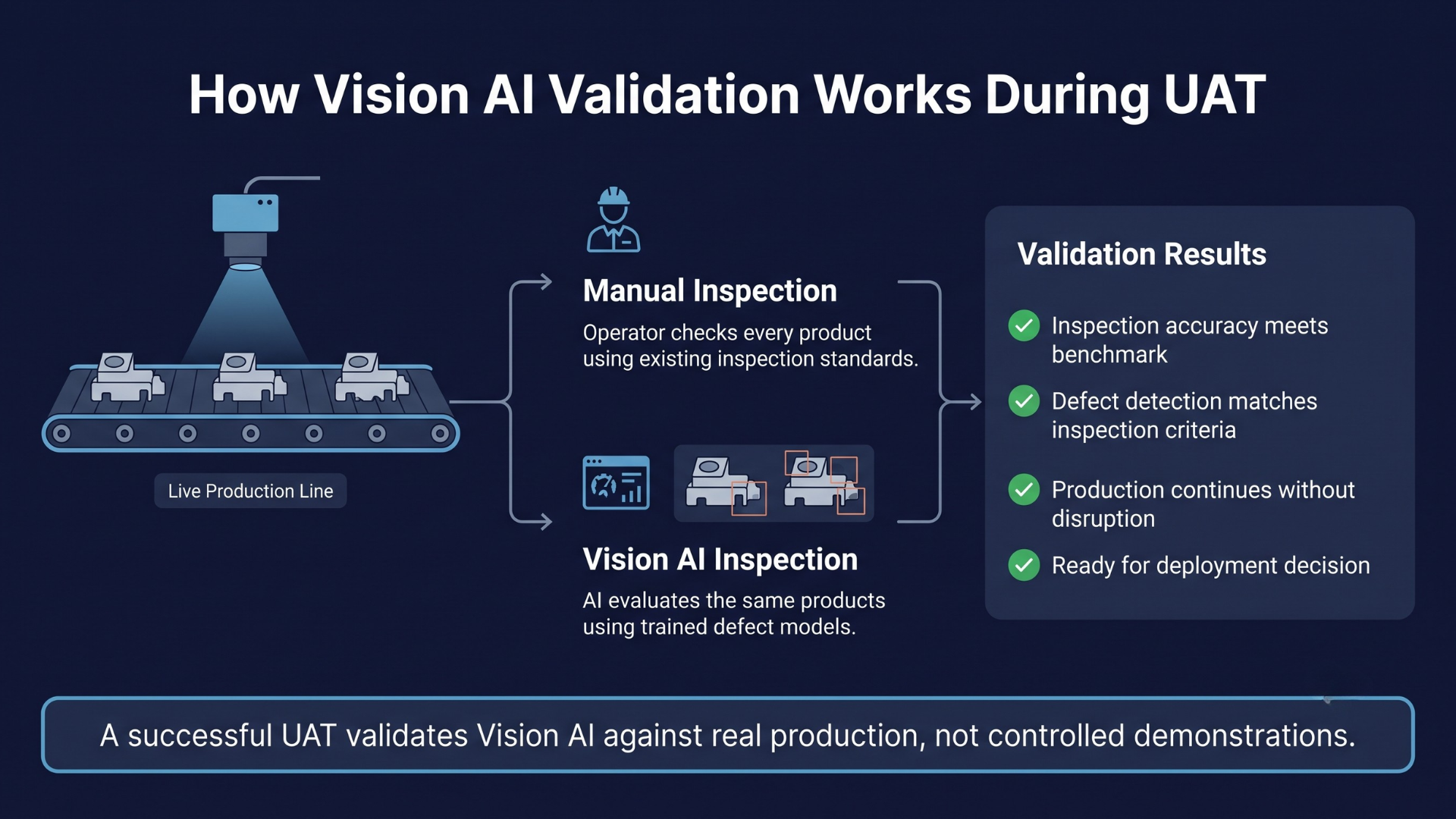
The final phase measures performance under real production conditions.
The AI system runs alongside the existing manual inspection process, evaluating the same products and comparing results directly. This provides a realistic benchmark rather than testing the model against the same data it learned from.
Manufacturers should be cautious of pilots claiming near-perfect accuracy after only a day or two. High numbers often indicate that the system has been validated against a narrow sample instead of the full variation seen on the production floor.
During this validation period, the cameras also capture operational data such as cycle times and throughput. Although quality inspection remains the pilot's primary objective, these additional insights give production teams a clearer understanding of line performance without deploying another system.
By Day 14, the decision becomes straightforward. Did the inspection accuracy meet the agreed benchmark? Did the system integrate without disrupting production? Did it reliably detect the defect types defined at the beginning of the pilot?
What to Prepare and What to Avoid
A successful pilot starts well before Day 1.
Manufacturers should identify the defect types that matter most, provide access for camera placement, and involve someone who understands the current inspection process in detail.
The most common mistakes are also the easiest to avoid. Trying to detect every possible defect usually leads to an unfocused pilot. A better approach is to begin with the two or three defect categories that have the greatest impact on quality.
Another common issue is skipping clear defect definitions before labelling begins, which often results in inconsistent training data and unreliable accuracy measurements. Finally, evaluating performance too early can be misleading. A model that performs well after initial training may still need refinement once it encounters the full range of production conditions.
Evaluating the Result
A successful pilot isn't the one with the highest accuracy shown in a demonstration. It's the one that proves its performance under the same conditions your production line faces every day.
At Seewise, that's the purpose of our 14-day Vision AI pilot. By validating the system against real product variation, existing inspection processes, and live production conditions, manufacturers gain a practical understanding of how the system will perform before making a deployment decision. It may not answer every question about long-term performance, but it provides something far more valuable: the confidence to move from pilot to production based on evidence rather than assumptions.

What a 14-Day Vision AI Pilot in a Factory Actually Looks Like