
After AI Goes Live: What Really Changes on the Shopfloor
AI going live is often treated like the finish line.
Model trained. System deployed. Dashboards ready.
But in real-world AI in factories, that’s where the actual shift begins.
Because AI in manufacturing operations doesn’t get tested during deployment. It gets tested during daily use across shifts, under pressure, when production targets don’t wait.
What changes isn’t just the system. It’s how people work, decide, and trust what they see.
Workflow Changes on the Shopfloor: Small Shift, Real Impact
Before AI, inspection is straightforward. An operator checks the product, makes a call, and moves on.
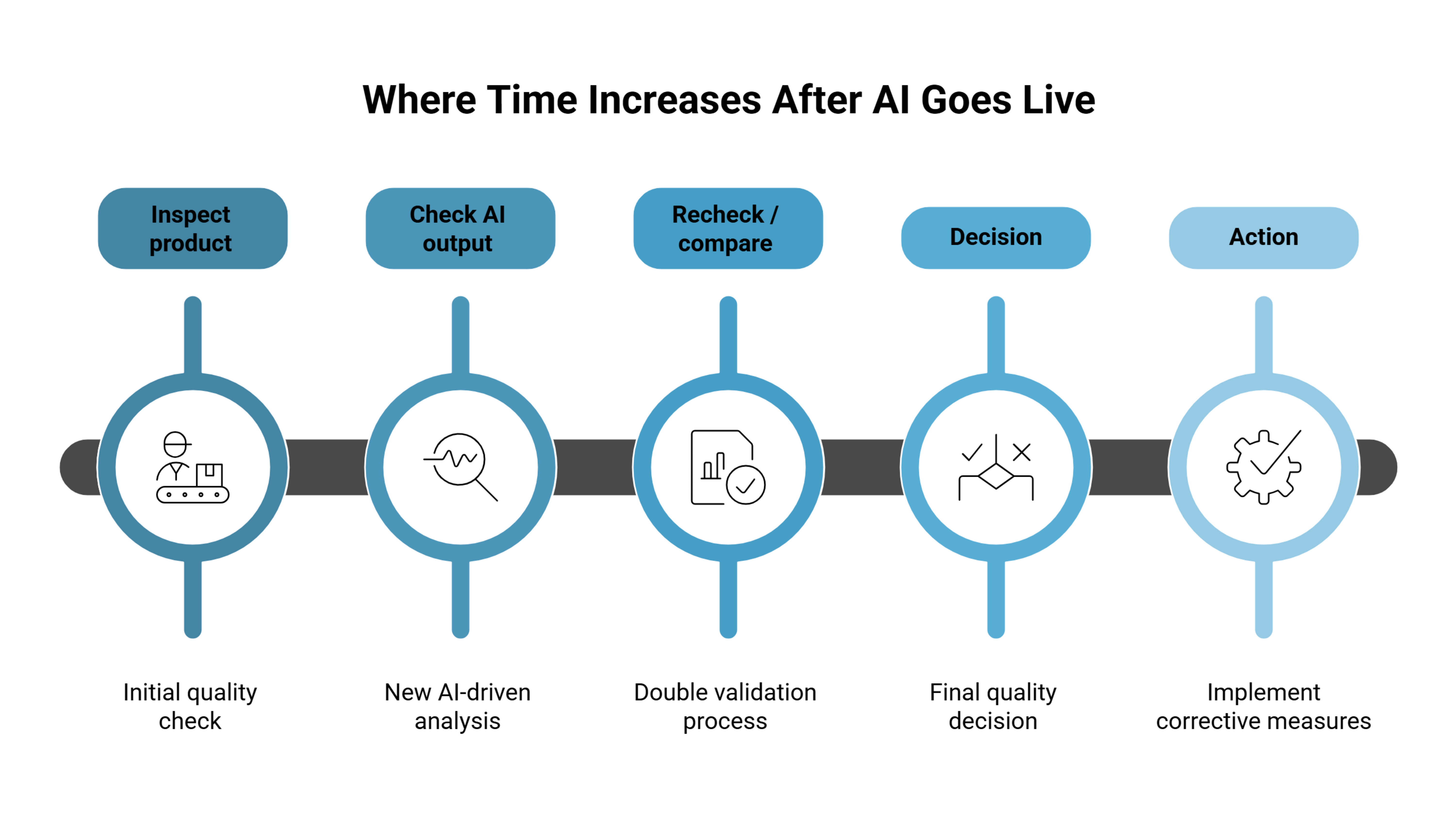
Once AI becomes part of shopfloor AI usage, that flow changes. There’s now an extra step in between. The operator checks the product, looks at what the system says, compares both, and then decides whether to follow it or override it.
That extra step slows things down in the beginning.
Operators don’t blindly follow AI. They double-check it.
For example, the system might flag a small surface scratch that usually passes inspection. The operator pauses, looks at it again, and tries to decide if it really matters. Or the system marks a product as defective, and instead of acting immediately, the operator rechecks it before stopping the line.
This constant back-and-forth adds time. Even when the system is working correctly, people take a while to get comfortable with it.
Over time, some of these checks reduce. But the workflow never really goes back to how it was before.
Decision-Making: More Inputs, More Hesitation
AI doesn’t just support decisions. It changes how decisions are made.
When AI flags something, operators are put in a position where they have to choose between what they see and what the system is telling them.
Early on, that choice isn’t easy.
Imagine a batch where the system flags multiple defects, but the operator only agrees with a few of them. What used to be a quick call turns into a pause. Sometimes it turns into a discussion. A supervisor might get involved, and the decision takes longer than it normally would.
Once AI becomes part of the process, decisions don’t feel as clear-cut. Responsibility also starts to blur. It’s no longer just the operator’s call or just the system’s output. It sits somewhere in between.
Trust and Skepticism: Built Slowly, Lost Fast
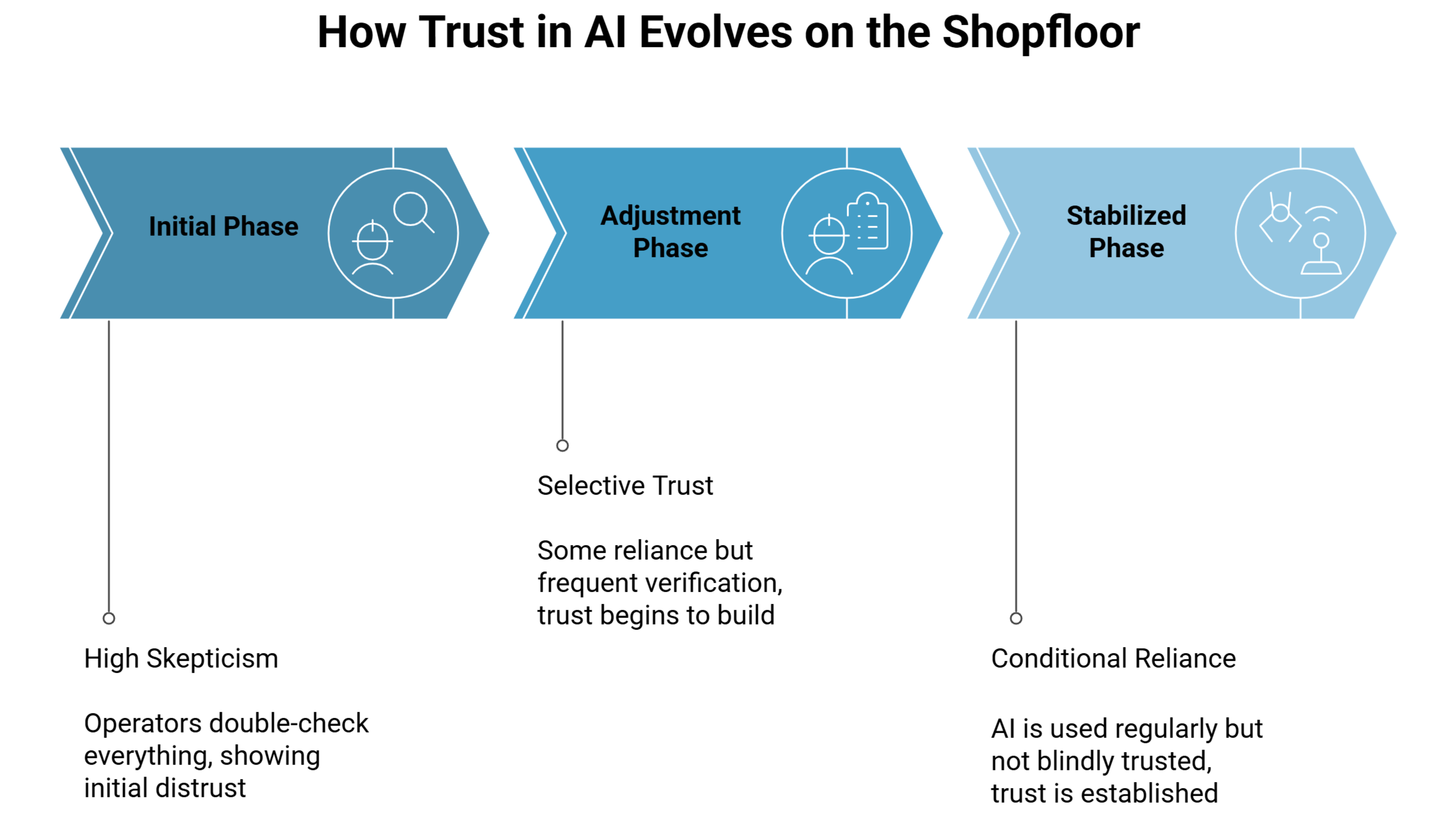
No one fully trusts AI from day one.
Teams test it. They watch how it behaves. They pay attention to where it gets things right, but more importantly, where it gets things wrong.
If the system misses something obvious during a busy shift, that moment sticks. Even if it has been performing well otherwise, operators immediately become cautious again.
Trust builds slowly, but it doesn’t take much to lose it.
This pattern shows up across most AI adoption in manufacturing environments. Confidence grows over time, but it’s fragile.
False Positives and Missed Detections: Behavior Starts Changing
AI errors don’t just stay within the system. They change how people behave around it.
When the system flags too many things that aren’t real issues, operators start paying less attention to alerts. At first, they check everything. Then they begin to ignore some of it. Over time, even important alerts can get overlooked.
On the other side, if the system misses a real defect, the reaction is immediate. Operators go back to manual checks. Trust drops much faster in these situations.
You’ll also notice differences across teams. Less experienced operators might rely more on the system, while experienced ones question it more often.
Same system, but different levels of trust.
That’s how shopfloor AI usage evolves in reality. Not just based on accuracy, but based on how people respond to it.
New Dependencies: You Don’t Notice Until It Breaks
Once AI becomes part of daily work, teams start depending on it without realizing it.
Inspections feel faster. Decisions feel supported. New operators rely on it to guide them.
But when the system is suddenly not available, the gap becomes obvious.
Work feels slower. Decisions take longer. People feel less confident, even though they were doing the same job before AI was introduced.
The system hasn’t just improved the process. It has changed what the team is used to.
What Actually Improves
Some improvements are clear.
Consistency is one of the biggest. AI applies the same logic across shifts without getting tired or distracted.
Routine decisions also become faster once operators start trusting certain types of outputs. Not everything gets double-checked anymore.
Data becomes easier to use as well. Patterns across batches and shifts that were difficult to track manually start becoming visible.
And for new operators, the system acts as a support layer. It helps them get up to speed faster, especially in standard scenarios.
These are real benefits, and they’re the reason AI in manufacturing operations continues to grow.
What Becomes Harder (and Stays Hard)
Some challenges don’t go away.
AI works well for common patterns, but edge cases still need human judgment. And those cases are often the most critical ones.
Responsibility becomes less clear when something goes wrong. It’s not always obvious whether the issue came from the system or from the decision made around it.
For experienced operators, there’s also a shift in confidence. When the system disagrees with them, they start questioning their own judgment. Over time, that can change how they make decisions.
At the same time, reliance on AI builds quietly. The more it’s used, the harder it becomes to work without it.
What Most Teams Don’t Expect
AI doesn’t simplify operations right away.
It adds a layer of complexity first.
There’s always a phase where work slows down, decisions take longer, and people feel less confident before things settle.
Even in setups where systems like Seewise are used to structure AI-driven quality checks, these changes still show up. The system doesn’t remove friction. It shifts where the friction exists.
What This Means in Practice
If you’re thinking about AI adoption in manufacturing, don’t just ask if the model will work.
Ask what happens when it’s wrong during a real shift.
Ask who makes the call when the system and the operator don’t agree.
Ask how long it actually takes for people to trust it.
Because once AI goes live, the system is only one part of the equation.
AI doesn’t reduce effort on the shopfloor.
It shifts it into judgment, doubt, and responsibility.

After AI Goes Live: What Really Changes on the Shopfloor